
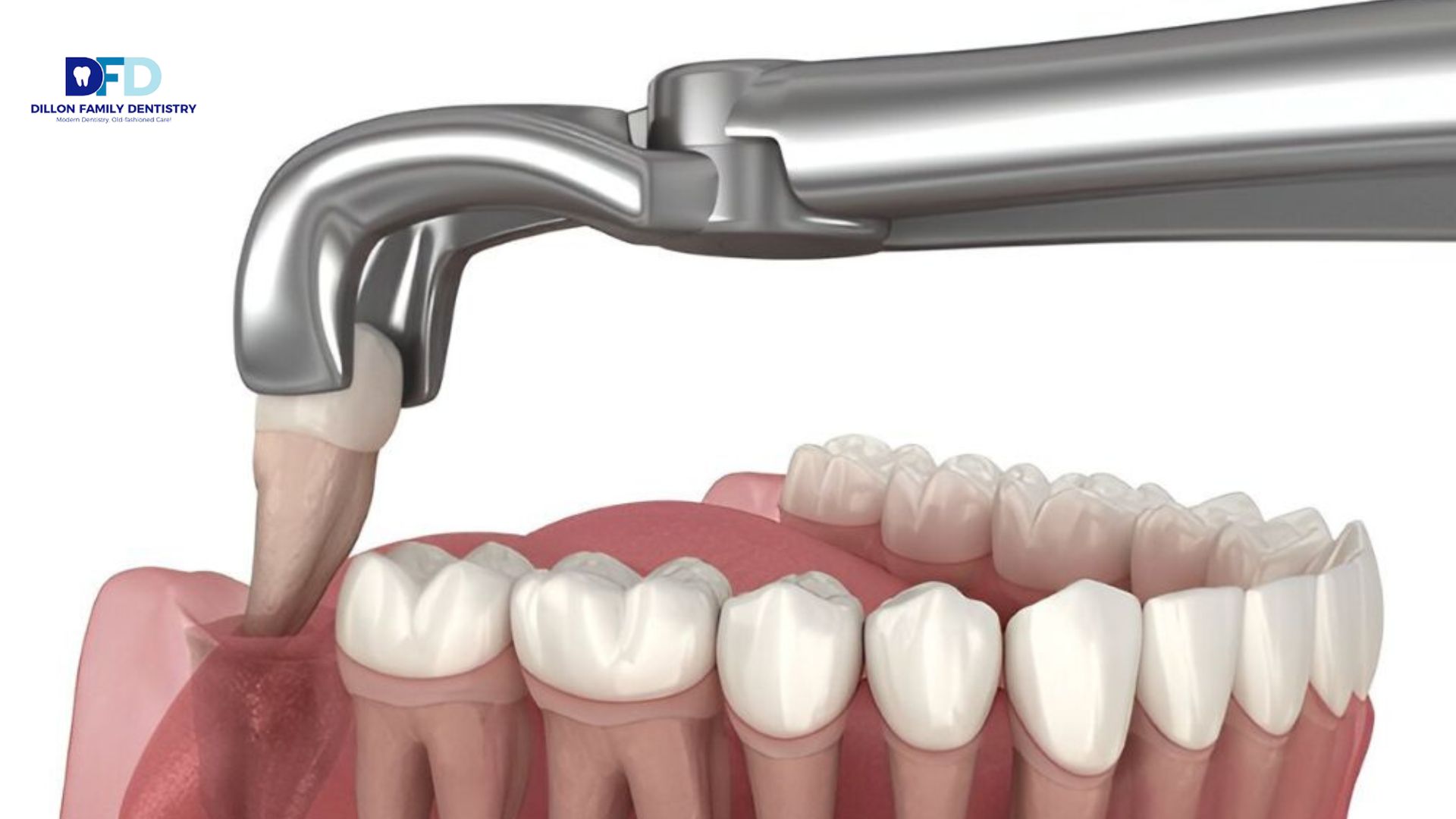
Dillon Family Dentistry in Bryn Mawr, Pennsylvania, offers gentle & affordable tooth extractions using the most current procedures available today. We offer same-day emergency services to all of our patients throughout the Mainline. With the help of local anaesthesia to ensure maximum patient comfort, you will also receive recommendations for tooth replacement options (dentures &/or dental implants) that can be done right here at Dillon Family Dentistry.
You probably never thought that if you needed dental treatment for something as serious as a tooth extraction, it would occur on such short notice to you from your local dentist! But what if it were now 10:00 pm on a Tuesday night? You have a bad toothache and are searching “tooth extraction main line” on Google, or you’ve just found out from your dentist that there’s no way to save your tooth. What do you want? You do not want to be sold; you want to be told! So here is what I will give you: I will provide you with the Honest, Practical Information you need to help you make an educated decision regarding your potential dental treatment/ tooth extraction, and also provide you with an idea of what to expect when you come to our Bryn Mawr, PA location for your dental treatment/ tooth extraction.
I’m Dr. David Dillon from Dillon Family Dentistry, right here on the main line. My team and I have been providing dental services to patients in Bryn Mawr, Haverford, Ardmore, Wynnewood, and throughout the entire Philadelphia area for years! Tooth extractions may sound like scary and painful procedures, but they do not have to be if they are done properly. Tooth extractions can be completed quickly, painlessly, and return you to a pain-free existence very quickly if you choose a dentist who has years of experience performing them properly.
A tooth extraction in Bryn Mawr at Dillon Family Dentistry involves numbing the area with local anesthesia, gently loosening the tooth, and removing it, all usually within 20 to 40 minutes. Most patients feel pressure, not pain, and are back to their routine within a few days. Same-day and emergency appointments are available.
When Does a Tooth Actually Need to Come Out?
This is the first question that comes to mind, and it has merit to it because losing a tooth without a good reason would be unfair. I always explore all conservative treatment options before resorting to suggesting the removal of the tooth, such as root canal therapy, crowns, and fillings. Removal should never be an initial course of action, but only after all other options have been exhausted.
That said, there are situations where keeping a tooth does more harm than good. Here are the most common ones I see in my Bryn Mawr practice:
- Severe decay: If a cavity has spread into the pulp and root canal therapy isn’t viable, the tooth needs to go.
- Advanced gum disease: When periodontal disease has eroded the bone holding a tooth in place, extraction may be the only way to stop the damage from spreading.
- Cracked or fractured teeth: A crack that runs below the gum line often cannot be repaired. Leaving it risks infection of the jawbone.
- Impacted wisdom teeth: Wisdom teeth that don’t have room to erupt correctly can push against neighboring teeth, cause infections, or develop cysts.
- Orthodontic crowding: Sometimes a tooth needs to come out to create space before braces or Invisalign treatment.
- Failed restorations: Teeth that have had multiple procedures and still can’t be stabilized often need extraction to protect your overall oral health.
If you’re not sure whether your tooth can be saved, the best first step is a comprehensive exam. Our family dental services in Bryn Mawr include a full evaluation so we can map out all your options before making any recommendations.
What Happens During a Tooth Extraction at Our Bryn Mawr Office?
A lot of people’s fear about tooth extraction comes from not knowing what to expect. So let me walk you through it, step by step.
Simple Tooth Extraction
This is for teeth that are visible above the gum line and structurally intact. Here’s the process:
- We take X-rays to assess the root structure and surrounding bone.
- The area is thoroughly numbed with local anesthesia. You’ll feel pressure during the procedure, but no sharp pain.
- I use a dental elevator to gently loosen the tooth in its socket, then forceps to remove it.
- The socket is cleaned, and gauze is placed to control bleeding.
Start to finish, most simple extractions are done in 20 to 40 minutes. Patients are consistently surprised by how quick and comfortable it is.
Surgical Tooth Extraction
If a tooth has fractured at the surface of the gum line, has not yet emerged completely, or has become impacted, the surgical extraction procedure is appropriate. For wisdom teeth, surgical extractions involve making a small incision into the gum tissue to gain access to the tooth. The tooth may need to be divided into sections to facilitate easier removal during some surgical procedures. During the procedure, a local anesthetic will be used, and patients may also request additional sedation options for added comfort during the procedure.
It typically takes longer (7-10 days) for patients to completely heal after a surgical extraction than it does after a simple extraction (1-3 days). I will explain everything to you that you will need to know before leaving the office.
Emergency Tooth Extraction in Bryn Mawr: What to Do When It Can’t Wait
A dental emergency does not care about your calendar. A tooth that is infected or a molar that is severely cracked can quickly turn into an emergency, especially if you are unable to sleep or eat due to the pain. If you are looking for “emergency tooth extraction near me” and you are in the Bryn Mawr or Main Line area, please call our office first.
At Dillon Family Dentistry, we always attempt to accommodate a patient with an urgent dental problem on short notice. If a tooth infection is not treated, it can spread to the jaw, neck, and other areas of the body, and is a situation that cannot be put off until next week. Please call us and tell us that you are having dental pain and require immediate assistance. We will do our very best to get you in on the same day.
Signs you may need an emergency tooth extraction:
- Severe, persistent toothache that doesn’t respond to over-the-counter pain relievers
- Swelling in the jaw, cheek, or neck
- A tooth that’s visibly cracked or broken
- Fever or foul taste associated with tooth pain (signs of infection)
- A loose permanent tooth from trauma or gum disease
Wisdom Tooth Extraction on the Main Line: Do You Really Need It?
Wisdom tooth extraction is one of the most common dental procedures in the country. But not everyone needs it. I don’t believe in extracting teeth that aren’t causing problems or aren’t likely to cause problems. When I evaluate wisdom teeth, I’m looking at:
- Whether they’re impacted (stuck under the gum or bone)
- Whether they’re putting pressure on adjacent teeth
- Whether they’re difficult or impossible to clean properly, raising the risk
- Your age and the stage of root development
In the case that your wisdom teeth are fully erupted, in a good position, and manageable to keep clean, then there is likely no need for extraction. However, if your wisdom teeth are impacted or there is a history of recurring infections associated with them, then there is little chance for their continued retention. Your treatment will be determined by an assessment of your X-ray and clinical evaluation, and not by a knee-jerk response to extract all teeth that are the same age as you.
Recovery After Tooth Extraction: What to Expect and How to Heal Faster
Recovery is usually the part patients worry about most. The good news is that for simple extractions, most people feel mostly fine within 1 to 3 days. Here’s what to do and what to avoid:
What to Do
- Bite on gauze for at least 30 minutes after the procedure to help the clot form.
- Apply an ice pack to your cheek for 10 to 20 minutes at a time to reduce swelling.
- Keep your head elevated for the first day or two, even while sleeping.
- Stick to soft foods like yogurt, mashed potatoes, smoothies (no straw!), and soup.
- After 24 hours, rinse gently with warm salt water after meals.
- Take ibuprofen or acetaminophen as directed for pain management.
What to Avoid
- No straws for at least 48 to 72 hours. Suction dislodges the blood clot and causes a dry socket.
- No smoking, which delays healing and dramatically increases infection risk.
- No vigorous rinsing or spitting in the first 24 hours.
- Avoid hard, crunchy, or chewy foods near the extraction site.
- Hold off on strenuous exercise for at least 2 to 3 days.
Dry socket is the most common complication I see, and it’s almost always preventable. It happens when the blood clot that forms in the socket is disturbed before healing is complete. If you develop sharp, radiating pain 3 to 5 days after extraction, call us right away. It’s treatable.
Affordable Tooth Extraction in the Main Line: Cost and Insurance
Cost is a real concern, and I’m not going to pretend otherwise. Here’s what the typical numbers look like in our area:
- Simple extraction: $150 to $300 per tooth
- Surgical extraction (non-impacted): $200 to $500 per tooth
- Wisdom tooth extraction (impacted): $300 to $700 per tooth
These ranges vary depending on the complexity of the case, the type of anesthesia used, and your specific anatomy. Many dental insurance plans cover 50% to 80% of extraction costs, especially when the procedure is medically necessary.
We work with most major dental