
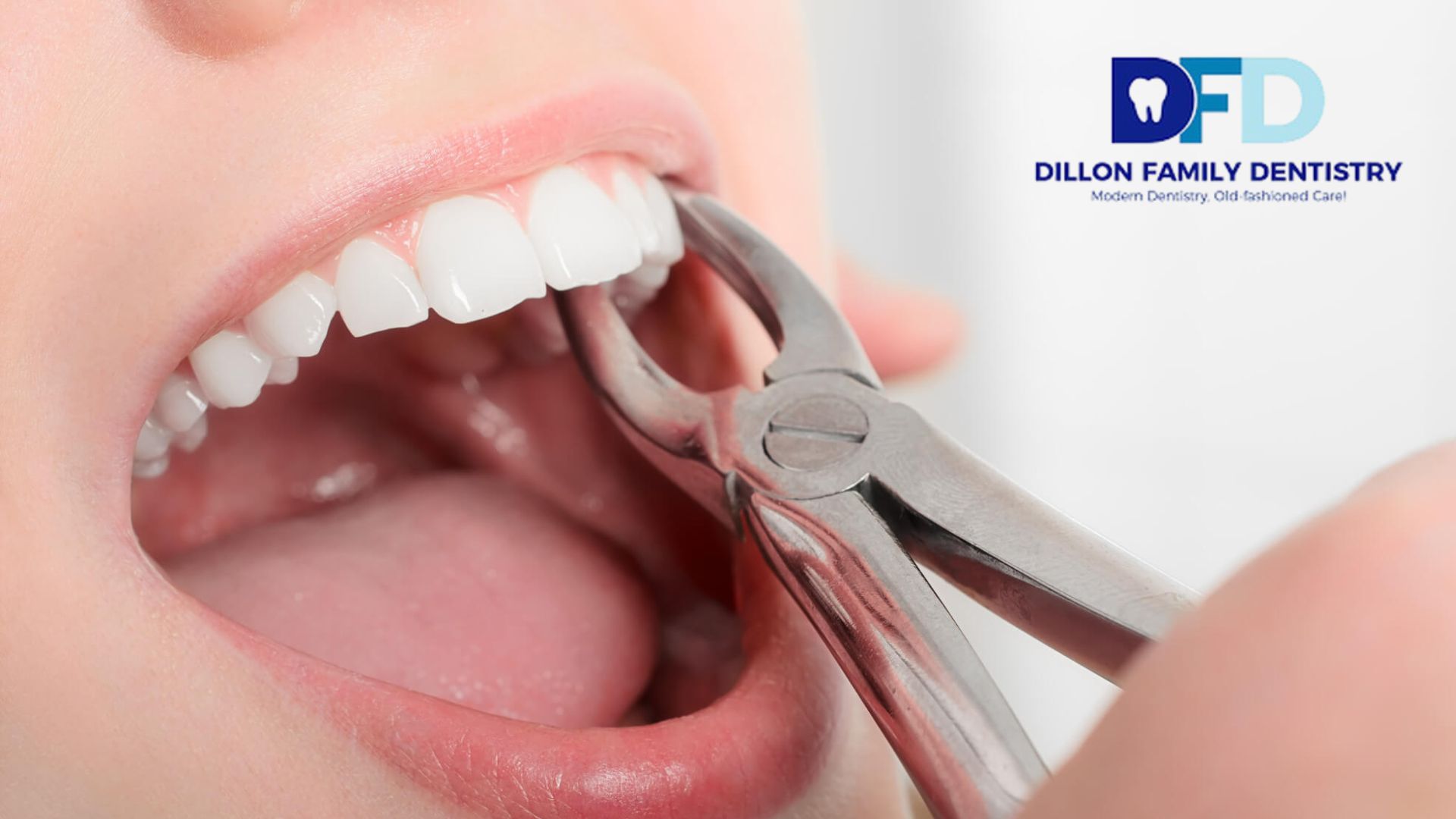
Extraction of a tooth when performed at an experienced, gentle dentist such as Dillon Family Dentistry (Bryn Mawr, PA) will usually be less painful than most people think it will be! With the use of modern-day local anesthetics, you will primarily feel only the pressure of the extraction, rather than any pain. After your tooth has been extracted, the expected level of tenderness can usually be alleviated by taking over-the-counter pain medications for 2 to 3 days following the extraction. For those patients who are anxious about their teeth or have anxiety-related issues along the Main Line, dental sedation options are available, including nitrous, so that all patients have the opportunity to be comfortable throughout their visit.
I’m going to tell you exactly how I would tell any of my patients sitting in my office in Bryn Mawr when they ask me whether or not they should have an extraction done:
Tooth extraction is not as bad as most people think, and most fears are unfounded or exaggerated.
I hear this every week from people living in or near Haverford. An individual suffering from a toothache for several months knows that the tooth will eventually have to be removed because it is badly damaged. They just don’t want to proceed because they fear that having it extracted will be so painful that they would prefer to endure the pain rather than have the tooth extracted. Someone from Ardmore has a son or daughter who requires an impacted wisdom tooth to be extracted, but they are convinced it will be a traumatic experience.
An individual from Wayne came to see me for the first time, already apprehensive even before speaking to me because a family member told them stories about how terrible the extraction process was many, many years prior to their having them removed.
The truth is that with the use of local anaesthetics available today and the ability to use sedation dentistry as needed, extraction will be nearly painless (aside from the feeling of pressure). You will know the difference between feeling pain and feeling pressure, and knowing the difference will completely change your experience as a patient undergoing extraction.
Now, I want to take you through all the steps involved in an extraction at Dillon Family Dentistry so you can have all the information necessary to make a well-informed decision regarding your treatment.
Does Tooth Extraction Hurt? The Honest Pain Level Breakdown
In a nutshell, the procedure will not hurt, but you’ll have some discomfort after anesthesia has worn off.
To clarify, there is a significant difference between the two terms ‘pain’ and ‘pressure,’ and these are terms that patients frequently connect. When a tooth is removed (extracted), the nerves around the tooth are injected with a local anesthetic so that you do not feel pain while we are removing the tooth. However, you will be able to feel the dentist working; you will experience physical pressure from when the dentist loosens and removes the tooth, and there will be some vibrations from the extraction as well. Despite these sensations, you will not feel the sharp, jolting pain that tends to come to mind with the word ‘extraction.’
Many of our patients who have anticipated their extraction for some time have left our office with comments such as “That was it? No way! Much better than I thought it would be!”
Pain level, on a practical scale:
- During the procedure (with proper anesthesia): Minimal to none. Pressure and movement, but not pain.
- Day 1 after extraction: Moderate soreness as anesthesia wears off. Manageable with ibuprofen and acetaminophen. Many patients report that taking both together as directed provides significant relief.
- Days 2 and 3: Often the most uncomfortable period. Swelling peaks around 48 hours. Still manageable with OTC medication and ice.
- Days 4 to 7: Steady improvement. Most patients feel substantially better by day 4 or 5.
- Week 2 onward: Most discomfort is gone. Gum tissue continues to close over the site. Full bone healing takes several weeks to months.
Simple Extraction vs. Surgical Extraction: How the Type Affects Pain
Simple Tooth Extraction
A basic tooth extraction is performed on teeth that have completely erupted through the gums. Teeth that are extracted can have many reasons for the procedure: decay, infection, overcrowding, or irreparable damage. The procedure starts with the application of a topical anesthetic on the gum area, followed by the injection of a local anesthetic; once the tooth area has become numb, we will begin loosening the tooth with a special instrument called an elevator and extract the tooth using a pair of forceps.
A basic extraction takes very little time to do because it usually takes only a few minutes per tooth and has a shorter healing time. Patients who undergo a simple extraction typically return to their normal daily activities in 48 to 72 hours, but the area does not heal completely below the skin for an extended period of time.
Surgical Tooth Extraction
Surgical removal of a tooth must be performed if it has not developed completely under the gum tissue, if it has broken off at the level of the gum, or if its roots are not only curved, but are also embedded deeply into the bone. Most surgical removal of third molars falls into this category of dental extractions. A small incision will be made through the gum tissue in order to access the impacted tooth, and sometimes the tooth will need to be divided into several pieces in order to be removed from the mouth.
The recovery period from surgical extractions is longer and more complicated than that of simple extractions. The amount of swelling and discomfort is generally greater with a surgical extraction than with a simple extraction. The normal healing time of five to seven days is required for the swelling and discomfort to resolve after a surgical extraction as compared to the normal healing time of two to three days for simple extractions. This is also where sedation dentistry plays the largest role in the comfort of the patient. For most patients who are nervous about having their tooth extracted surgically or who have a low threshold for pain, sedation enables the patient to have the experience of the extraction being not merely tolerable, but also substantially comfortable.
Sedation Dentistry on the Main Line: Your Options at Dillon Family Dentistry
Not every patient requires sedation when having a tooth extracted; however, sedation can be very beneficial for patients who have severe dental anxieties, have a strong gag reflex, are very sensitive to pain, or have complex surgical cases. In each extraction consultation at our Bryn Mawr office, we discuss sedation as one of the options available to you so you feel comfortable moving forward.
Sedation options we offer:
Nitrous Oxide (Laughing Gas)
The most frequent choice we offer for the sedation of anxious patients is nitrous oxide. This option is a gas delivered via the patient’s nose through a mask. Once they begin inhaling the gas, within minutes, they will experience a sense of calm and relaxation. They remain fully conscious during the procedure and communicate freely with our dental staff until completion.
Once we remove the mask, the effects of nitrous oxide will dissipate very quickly. Therefore, you can drive yourself home from our Bryn Mawr location and resume your normal activities on the same day.
The ADA approves of nitrous oxide and considers it completely safe. Many patients prefer to use nitrous oxide because it helps them reduce their anxiety but does not require an extensive recovery period like other, more deeply sedating options.
Local Anesthesia
Local anesthesia alone is adequate to perform most ordinary extractions. We first apply a topical gel to numb the area so that you will only feel a very brief sting when receiving your anesthetic injection. Once your area is numb, the extraction will proceed without any pain. We take appropriate steps to make sure that you receive an adequate amount of anesthetic prior to starting, and we will check in with you frequently throughout your extraction.
If you are feeling any discomfort during the extraction, please let us know right away. If so, we will provide you with additional anesthetics without question. Your comfort is our primary consideration.
What to Expect After Tooth Removal: A Day-by-Day Guide
The First 24 Hours
The day following your wisdom tooth extraction will play an important role in how well you recover from your extraction. Your body’s first priority after your extraction will be to form a stable blood clot in your empty tooth socket (the area where the tooth was removed). This stable clot will protect all the exposed bone and nerve endings that were underneath your tooth and will be the basis for the healing of the surrounding soft tissue. If the clot becomes dislodged, this can lead to the development of dry socket, which is a condition in which the underlying bone and nerve endings are exposed and can lead to considerably more pain.
What to do in the first 24 hours:
- Bite firmly on the gauze we provide for the first 30 to 45 minutes after leaving our office.
- Apply an ice pack to your jaw: 20 minutes on, 20 minutes off, to manage swelling.
- Rest. Do not engage in strenuous activity that raises your heart rate, as this can increase bleeding.
- Eat only soft foods: yogurt, applesauce, mashed potatoes, smoothies (without a straw).
- Do not use a straw, smoke, or spit vigorously. All three create suction that can dislodge the blood clot.
- Take your pain medication as directed before the anesthesia wears off, not after the pain has already spiked.
Days 2 and 3
The highest point for swelling occurs between days two and three (or 48 hours following surgery). After that, swelling begins to taper off. There may also be bruising on your jaw or a portion of your cheek, which are both normal findings from the body’s healing process (inflammatory response) and will eventually disappear. This will be the point in time where most patients experience some discomfort; nevertheless, both over-the-counter ibuprofen (Advil or Motrin) and acetaminophen (Tylenol) can control any discomfort effectively.
After approximately 24 hours, gentle saltwater rinses can be initiated. (For every 8 ounces of warm water, use 1/2 tsp (one-half teaspoon) of salt.) When rinsing your mouth gently, let water fall from your mouth rather than forcefully spitting. Continue eating soft foods.
Days 4 Through 7
By the time you reach day four, the overall improvement should be significant; the socket closure will now have formed new living tissue inside as the amount of pain is continuing to decrease each day, and you will likely begin to return to a more standard diet as soon as you feel comfortable doing so. The area of extraction may continue to be tender to the touch, but for most patients, there should be minimal discomfort day-to-day at the end of their first week.
If pain is continuing to increase after day three (instead of improving), you should call our Bryn Mawr office immediately if you develop any of the following symptoms: A foul taste in your mouth, a throbbing pain that radiates to your ear or jaw, or if you develop a fever; these are indications of either a dry socket or an infection, both of which will need to be treated immediately.
Week 2 and Beyond
After two weeks, most patients should not be experiencing significant pain and are able to return to their activities of daily living. Simple extractions will see the gum tissue healing over the extraction site within one to two weeks. The underlying bone will take longer (10 weeks) to show significant new bone formation. The majority of the bone healing will generally take about four months; this will not occur at a rapid enough pace for you to notice effects on a day-to-day basis.