
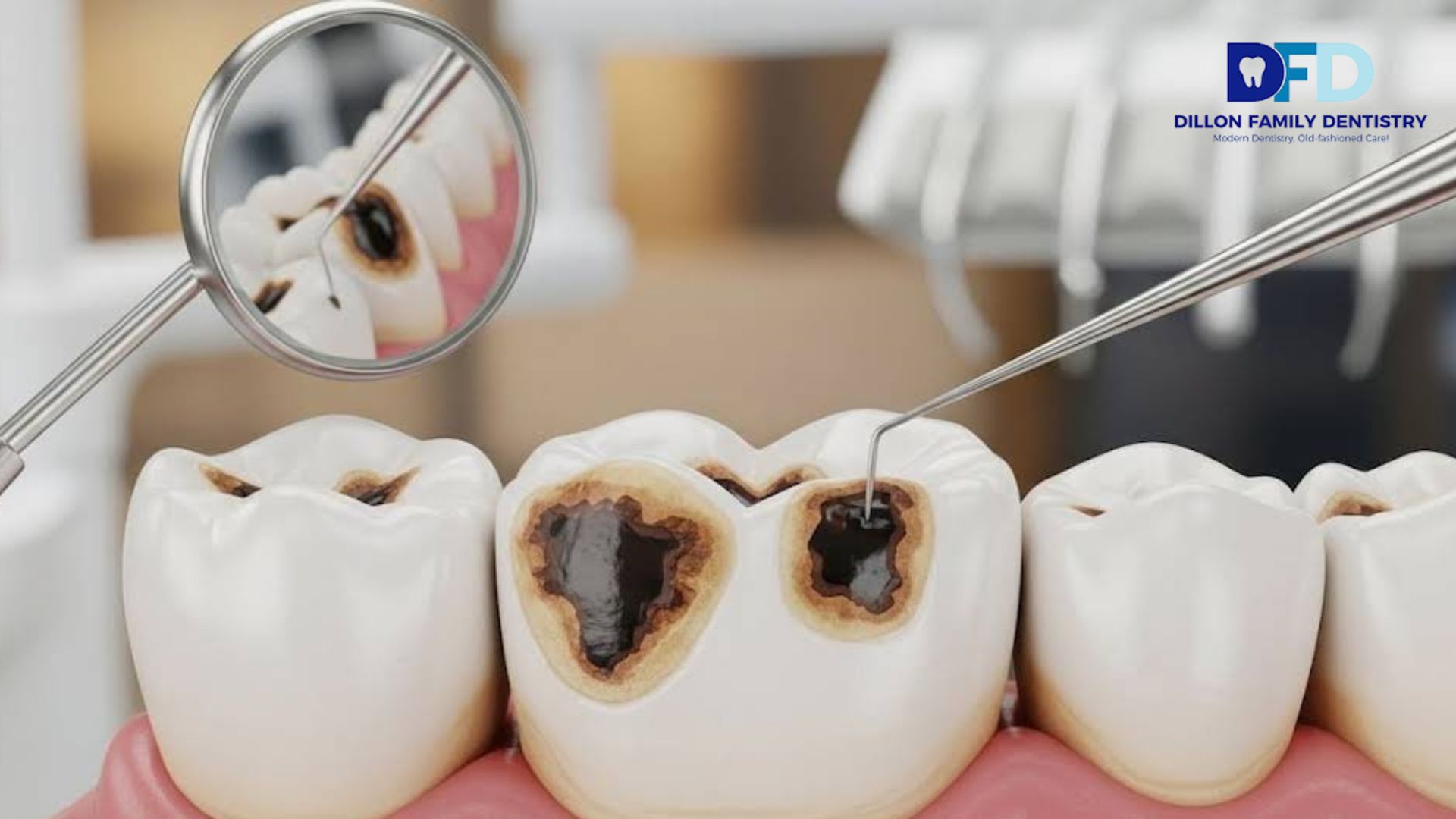
A black spot on a tooth is one of those discoveries that stops people cold during their morning brushing routine, and the first question is almost always the same: Is it a cavity? At Dillon Family Dentistry on East Lancaster Avenue in Bryn Mawr, PA, Dr. David Dillon sees this concern regularly from Main Line patients, and the answer is never one-size-fits-all. A black spot can be a surface stain that needs cleaning, an early cavity that needs a small filling, or, in some cases, a sign of more advanced decay requiring prompt attention. The only way to know which it is, and to get it treated before it becomes a bigger problem, is to have it evaluated by your dentist.
You are brushing your teeth, you catch a glimpse in the mirror, and there it is: a small black or dark spot on one of your teeth. Maybe it is on a back molar where you could not see it easily before, or maybe it is somewhere more visible that has you genuinely concerned. Your first question is the right one: Is it a cavity?
I am Dr. David Dillon, and from our office on East Lancaster Avenue here in Bryn Mawr, I can tell you that this is one of the most common questions I get from patients across the Main Line. The honest answer is: it might be a cavity, and it might not be. A black spot has several possible causes, ranging from surface staining that requires nothing more than a professional cleaning to early tooth decay that can be treated with a small filling if caught now, to more advanced decay that needs more involved care. What it is not, ever, is something to ignore or put off having evaluated. Here is exactly what you need to know.
What Is a Black Spot on a Tooth? The Four Main Possibilities
Not every dark mark on a tooth represents the same problem, and the distinction matters enormously for how it should be treated. Here are the four most common causes I see at my Bryn Mawr practice:
1. Tooth Decay (Cavity)
Dental caries, commonly called a cavity, is the most serious possibility and the one patients are most concerned about, rightly so. A cavity forms when bacteria in the mouth produce acid that demineralizes and destroys tooth enamel. In the early stages, this produces a white or chalky spot. As decay progresses through the enamel and into the dentin below, the affected area darkens to brown and then black as the destroyed tooth structure stains.
The critical thing to understand is that early-stage cavities, even ones that appear as visible black spots, are often completely painless. Tooth pain from a cavity typically does not develop until decay reaches the inner pulp, where the nerve lives. By that stage, a simple filling is no longer sufficient, and root canal therapy is likely needed. A small black spot that is an early cavity is a routine filling. The same spot ignored for another year may be a crown or a root canal. That is not an exaggeration. That is the documented progression of untreated decay.
2. Surface Staining (Extrinsic Discoloration)
Not every black mark is decay. Heavily pigmented foods and beverages, including coffee, black tea, red wine, and dark sauces, deposit chromogens on the enamel surface over time. These deposits can concentrate in specific areas, particularly in the natural grooves and pits of the chewing surfaces of molars, producing what looks exactly like a small dark cavity to the naked eye. Tobacco use, both smoked and chewed, is among the most aggressive causes of this type of dark surface staining.
The good news about extrinsic staining is that it is purely cosmetic and has no clinical significance for tooth health. A professional cleaning removes most surface staining, and teeth whitening addresses the rest. The challenge is that staining and early decay look nearly identical without a clinical probe and X-ray. This is why a professional evaluation is always the right move when you notice a new dark spot, even if you suspect it is just a stain.
3. Black Tartar at or Near the Gum Line
You may notice a dark line or series of dark spots, specifically at the gum line on the inside surfaces of the lower front teeth or near the gum margins on other teeth. This is almost always black tartar, also called subgingival calculus. Regular yellowish tartar is calcified plaque. Black tartar forms when plaque calcifies below or at the gum line and becomes stained by blood pigments from the inflamed gum tissue and bacterial metabolic products. It is associated with gum disease and is significantly more difficult to remove than regular tartar.
Black tartar can only be removed by professional cleaning, specifically the type of deep cleaning we perform at our Main Line family dental practice. It cannot be brushed away at home. Its presence is also a signal that we need to assess the health of the gum tissue in that area.
4. Staining from Old Dental Work
If you have had fillings or other restorations, particularly older amalgam (silver) fillings, the metal can leach into the surrounding tooth structure over time and create a gray or dark discoloration in the tooth around or beneath the restoration. This is called amalgam tattooing of the tooth and is cosmetic in nature, not a sign of active decay. However, any old restoration warrants evaluation at a dental visit, as older fillings can fail at the margins and allow new decay to develop beneath or around them.
How to Tell a Stain from a Cavity: What I Look for in the Exam Room
This is the question I hear most often, and I want to be direct: you cannot reliably tell the difference between a surface stain and an early cavity based on visual inspection alone, even with a mirror and good lighting. Both produce black or dark brown spots. Both may be painless. The spot location gives some clues, but it is not definitive.
Here is what we do at Dillon Family Dentistry to make the distinction:
- Clinical probing: I gently explore the spot with a dental explorer. Healthy enamel and surface staining feel smooth and hard. Decay has a characteristic texture: slightly soft or sticky, and the explorer may get caught in a pit. This tactile assessment is one of the first and most informative diagnostic steps.
- Digital X-rays: Bitewing and periapical X-rays reveal decay between teeth and beneath existing restorations that cannot be seen at all during visual inspection. We use digital radiography at our Bryn Mawr office, which reduces radiation exposure compared to traditional film X-rays and provides images I can review with you on-screen immediately.
- Visual examination with magnification: Using a dental loupe or microscope, we can assess the texture, margins, and surface characteristics of a suspicious spot in detail, which is impossible with the naked eye.
- Transillumination: In some cases, shining a focused light through the tooth reveals internal decay patterns that are not visible otherwise.
With these two tools, I can come to an answer that is not open to question. Stained wood has some degree of “slickness” when felt underhand. Wood with ongoing decay or other structural involvement has a characteristic consistency of “softness”, or as I call it, a “toilet tissue” feel. If there is any uncertainty about the appearance of a potential problem, where there is a “spot” that has an unusual or questionable appearance, I will evaluate the area again at the next appointment for an injection rather than “drilling” on it unnecessarily. As a rule of thumb, the most conservative procedure is taken for any tooth, such that the health of the tooth is maintained at all times.
The Stages of Tooth Decay: Why Timing Changes Everything
Tooth decay does not arrive fully formed. It progresses through distinct stages, each of which has implications for how it must be treated. Understanding the stages helps explain why I am so emphatic about early detection.
Stage 1: Demineralization (White Spot Lesion)
Early signs of enamel decay occur before a tooth develops into a cavity. These early decay signs can be seen as a white or chalky spot. If treated early with fluoride and good hygiene, some enamel loss due to acid attack can occasionally be stopped without drilling. During the earliest stage of decay, the enamel is still intact and capable of being restored with preventive measures.
Stage 2: Enamel Decay
Once the acid has fully penetrated the enamel surface, a true cavity exists. The area becomes brown or black and slightly soft. Treatment is a composite filling, which we place in the same appointment as the diagnosis in most cases. These are small, conservative restorations that preserve as much natural tooth structure as possible. We have placed only metal-free, tooth-colored composite fillings at our Bryn Mawr office for over 25 years because they bond to the tooth structure and support what remains, rather than creating the stress that older amalgam restorations can impose.
Stage 3: Dentin Decay
Enamel is the hardest substance in the body. Dentin, the layer beneath it, is softer and more porous, and once decay reaches it, progression accelerates significantly because acid moves through dentin much faster. At this stage, sensitivity, particularly to cold and sweets, often begins. Treatment is still a filling, but a larger one. Depending on how much tooth structure has been lost, a dental crown may be needed to restore proper form and function.
Stage 4: Pulp Involvement
When decay reaches the pulp chamber, the inner space containing the tooth’s nerve and blood supply, the character of the pain changes from sensitivity to persistent, throbbing pain. At this stage, root canal therapy is required to remove the infected or inflamed pulp tissue before the tooth can be restored with a crown. This is significantly more involved and more expensive than a filling. It is the stage that patients reach when they ignore a painless black spot for too long.
Stage 5: Abscess and Tooth Loss
Untreated pulp infection leads to a dental abscess, a pocket of bacterial infection that can spread to the surrounding bone and tissue. At this point, extraction may be the only viable option. This is the outcome that begins as a small black spot noticed during morning brushing.
Location Matters: What a Black Spot’s Position Tells Us
Where on the tooth you find a dark spot provides diagnostic clues, even before we perform the formal exam:
On the Chewing Surface (Occlusal)
The deep grooves and pits of the biting surfaces of molars are the most common site for cavities in adults and children alike. These grooves are narrow enough that toothbrush bristles cannot fully clean them, and food particles and bacteria accumulate. A black spot or pit in the center of a molar’s chewing surface is highly suspicious for decay, though it can also be staining concentrated in those grooves. This is the site where dental sealants provide the most protective benefit.
Between Teeth (Interproximal)
Cavities between teeth are often invisible to visual inspection entirely and show up only on X-rays as dark shadows between the tooth roots. If you notice a dark shadow at the contact point between teeth, or if you have pain when flossing, an interproximal cavity may be the cause. This is another reason that regular X-rays are not optional. They catch decay in locations that are simply not visible any other way.
Near the Gum Line
Dark spots at or just below the gum line are more commonly black tartar than decay in patients with intact root surfaces, but in patients who have experienced gum recession, root surface decay is a real concern. Root surfaces do not have a protective enamel layer, making them significantly more vulnerable to decay. A