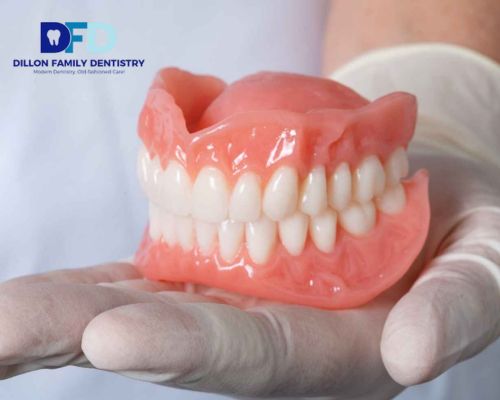
Most dentures need replacement every 5-7 years due to natural wear and changes in your mouth. Watch for warning signs like looseness, discomfort, difficulty eating, or visible damage. At Dillon Family Dentistry in Bryn Mawr, we help Main Line residents maintain comfortable, functional smiles with expert denture services.
Imagine this: you are out to eat with your family at one of Bryn Mawr’s fabulous restaurants on Lancaster Ave (maybe at Tango or Savona) when suddenly you feel your dentures shift in an embarrassing way. You are also talking to friends at the local farmers’ market and realize your speech is not quite what it used to be. These scenarios can be frustrating and even embarrassing at times.
What I’d like for you to understand is that dentures are amazing products that will give you back your ability to eat, drink, and smile confidently, but they are not made to last a lifetime. At Dillon Family Dentistry, located on East Lancaster Avenue in Bryn Mawr, we have been providing families in the Main Line with denture care for many generations. I have personally watched patients with uncomfortable, worn-out dentures and how their overall quality of life has dramatically improved after being fitted for a new pair!
This detailed resource will assist you in comprehending all facets of replacing dentures, including timing, reasoning, and expectations. You will find useful information that allows you to better manage your oral care, regardless of whether you have conventional complete or partial dentures and are curious about today’s advancements in implant-anchored alternatives.
Why Dentures Don’t Last Forever: Understanding the Reality
Let me be frank with you: the anatomy of your mouth is continually changing. Once your natural teeth have been extracted from your jaw, the bony ridge that supported them will begin to gradually diminish through a process known as bone resorption. This is true for all of us; however, it means that the fit of your dentures will likely change over time.
To illustrate how this change happens, consider how your dentures were originally custom-made based on the original configuration of both your gums and your jawbone. After you receive your dentures, they will still maintain the same contour to fit perfectly into your mouth. However, the bony structure of your jaw will continue to change over time through the process of bone resorption. Over the months and years, as the jawbone continues to change shape, those initially fitting dentures will begin to no longer provide a proper fit due to the jawbone’s ongoing resorption.
So, just as your feet may have once been properly fitted with shoes that matched the contour of your feet five years ago, and the shoes may be in excellent condition, the shape of your feet will still be different from what they were five years ago.
Additionally, dentures themselves experience wear and tear. The materials, typically acrylic resin and porcelain or composite teeth, gradually break down from:
- Daily chewing forces (thousands of bites per day)
- Cleaning and handling
- Exposure to hot and cold temperatures
- Chemical interactions with foods and beverages
Typically, a person’s denture will last anywhere from five to seven years. There are some very well-made dentures that, with proper care, may last up to 10 years; however, this is usually an exception rather than the rule. In the Main Line area (Bryn Mawr, Haverford, Narberth, Wayne), generally, I tell my patients they should replace their dentures every five to seven years.
Clear Warning Signs: When Your Dentures Are Telling You It’s Time
Your dentures will give you signals when they’re ready for replacement. Let me walk you through the most common signs I see in my Bryn Mawr practice:
1. Loose or Slipping Dentures That Won’t Stay Put
This is the number one complaint I hear. If you find yourself constantly adjusting your dentures, or if they shift when you’re talking to colleagues at Harriton High School’s football games or enjoying a performance at the Bryn Mawr Film Institute, that’s a red flag.
What’s happening: The change in your jawline due to bone loss, as mentioned previously, has caused a dramatic difference in how your jawbone fits into your mouth and can no longer provide adequate suction or stability for dentures. This could lead to you using larger amounts of adhesive than ever before – sometimes daily, up to three times per day – just so that dentures will stay in place long enough to complete normal daily tasks.
Why it matters: When you have loose dentures, you are constantly clenching your jaw in an effort to keep them in place, which can result in headaches or other issues with your temporomandibular joint (TMJ). The friction created by your dentures against your gums can also lead to painful sores on your gums as well.
2. Persistent Discomfort, Sore Spots, or Gum Irritation
Once you have properly adjusted to your new dentures, they should feel comfortable. If you find that you have tender spots on your gums or are experiencing chronic soreness, then you may have a problem with your dentures.
What’s happening: Your denture is pressing against your gums in a way that it shouldn’t be. Your denture will rub against your gums, causing pressure points and wearing down your gum tissue over time. Constant contact can cause inflammation of your gums and create an infection, as well as possible irritation to the bone beneath your gum tissue.
Why it matters: Chronic gum irritation can cause long-term oral health issues. I have seen patients who developed oral infections or fungal infections (such as denture stomatitis) from wearing poorly fitting dentures for too long.
3. Difficulty Eating Your Favorite Foods
Have you started avoiding certain foods? Maybe you skip the fresh corn at the Bryn Mawr Farmers Market, or you’ve stopped ordering steak when you dine out in Gladwyne or Ardmore. If chewing has become a challenge, your dentures are failing you.
What’s happening: Worn denture teeth lose their chewing surfaces, becoming smooth and ineffective. Or, if the fit is poor, food particles slip underneath the denture, making each bite uncomfortable or unstable.
Why it matters: It’s not all about how much you don’t eat because of difficulties chewing the food. If you can’t chew well, you may avoid the nutritious types of foods, such as fresh fruits and soft vegetables, which will have a negative effect on your health. Some people have told me that they have begun to cut up their food into smaller pieces and only eat soft, processed foods, which is neither ideal from a nutrition standpoint nor from a digestive health standpoint.
4. Changes in Your Speech or Clicking Sounds
Your dentures play a crucial role in speech. If you’ve noticed that certain sounds (especially ‘S’ and ‘F’) have become harder to pronounce clearly, or if your dentures click when you talk, that’s a sign they’re no longer fitting correctly.
What’s happening: If your dentures are not fitted properly or if they are loose, they will move slightly as you speak and make a clicking noise when you say certain sounds. Loose-fitting, worn dentures will not give your tongue the reference point it needs to make those sounds correctly.
Why it matters: Communicating effectively requires clear language to give yourself the ability to successfully communicate with other people, including family, friends, co-workers, and even strangers in both formal and informal settings. You have the right to be able to express yourself clearly; it doesn’t matter if you are giving a talk in Philadelphia, teaching some kids at a prestigious school on the Main Line, or having a friendly conversation with neighbours in Coopertown.
5. Visible Wear, Damage, or Discoloration
Before removing the dentures from where they were just weeks ago for the last time, check them over carefully in adequate lighting and look for:
- Cracks, chips, or fracture lines (even tiny hairline cracks).
- Any discoloration or staining that will not come clean with normal cleaning.
- Shortened or flattened worn-down areas on teeth (which were once long).
- Areas of roughness or pitting on your surface in order to find an area for infection to grow.
The reason for any of this: The material itself is deteriorating due to excessive wear from age and usage. If a very small crack develops, the entire structure has already been weakened and also serves as a breeding ground for infection-causing bacteria.
The effect of the damage: It will be impossible for you to have the ability to chew food properly if one of these damaged areas happens to break off (usually happens at the least convenient time). If you do not have the proper equipment (dentures), you will look completely out of character/definition and reduce self-confidence.
6. Changes in Your Facial Structure or Appearance
This is a subtle, but very important point. Look at pictures of yourself from the time you first got your dentures to how you look now. Do you notice:
- Sunken cheeks or “collapsed” face
- Lips that are thinner, with a pursed look
- More pronounced wrinkles around your mouth
- Sagging jawline/jowls
What’s going on? Natural or artificial, your teeth provide support for the muscles and soft tissues of your face by creating an underlying support structure. When dentures do not fit well, they cannot provide any support, and as a result, your face begins to collapse or sag inward.
Why is this important? Beyond aesthetics, the collapse of the face affects oral function. With new and well-fitted dentures, you can restore much of the contour to your face, thus giving you a more youthful appearance as well as improved function.
7. Your Dentures Are Simply Getting Old (5+ Years)
Even though you might think your dentures are in good condition, one valid reason to replace them is age alone. If you have had your current set of dentures for longer than five or seven years, it is at least time to have them evaluated by a professional.
What is happening: The materials used in making dentures are deteriorating gradually. The changes to your mouth are also happening gradually, so you likely do not realize how poorly the dentures are fitting in your mouth. The reason for this analogy is the same as a pair of eyeglasses that you have had for a long time; while they still work, they do not work as well as when they were brand new.
Why this is important: If you wait until you have serious problems, you will be sacrificing comfort, health, and possibly a lot of money. By replacing your dentures proactively, you will prevent the types of issues I have outlined above.
Denture Replacement vs. Repair: Making the Right Choice for Your Situation
One of the most common questions I get at our Bryn Mawr practice is: ‘Can you just fix these, or do I really need new ones?’
The answer depends on several factors. Here’s my honest assessment:
When Denture Repair or Relining Makes Sense
Denture relining is the process of updating the material used to construct the bottom of your denture, allowing it to fit better against the gums. Some good reasons to try relining are:
- Your current set of dentures (they should be less than three to four years old) still has a good base and teeth, and they are working well for you.
- You are beginning to notice some looseness as a result of recent changes in bone structure.
- You need a temporary solution but have an established budget, and
- You would like to prolong the life of your present set of dentures.
There are simple repairs (such as fixing a broken clasp, partial denture, or cracking) that will allow you to get more time, but they are not long-term solutions.
When Full Denture Replacement Is Necessary
If you have the symptoms I described above, a complete replacement is the better option almost every time. You should definitely consider a complete replacement if you have any of the following conditions:
- Your dentures are at least 5 years old
- You have already repaired or relined your dentures multiple times
- You see visible wear and tear on (or damage to) the teeth
- Your jaw has changed dramatically since your last denture fitting
- You have chronic discomfort or problems with function
Think about your dentures as if they were an old tire – each time you patch your tire, you will eventually need new tires for safety and performance. The same is true with your teeth.
Modern Denture Options: What’s Available in Bryn Mawr
If you’ve decided it’s time for new dentures, you have more options today than ever before. At Dillon Family Dentistry, we offer a range of solutions tailored to your specific needs, budget, and lifestyle.
Traditional Full Dentures
A classic complete denture is usually more comfortable and better looking than anything available just 10 years ago. Modern complete dentures have far superior materials than before, a more natural-looking tooth design, and a much more accurate fit.
Because complete dentures are removable, they could be ideal for many patients who have lost all their teeth in one or both arches and desire an easy-to-use, reasonably cost-effective alternative to surgery.
Partial Dentures
If you still have some healthy natural teeth, custom partial dentures can replace just the missing teeth. These attach to your remaining teeth with precision clasps or attachments.
Best for: Patients with several missing teeth who want to preserve their remaining natural teeth.
Implant-Supported Dentures (The Game-Changer)
Modern dental techniques produce great results, and implant-supported dental prosthetics are just one example of this. There are many impressions with removable prosthetics that snap into place using two to four titanium implant supports that have been fused into the patient’s jawbone. This means that the dental prosthetics have a very secure fixation on the jaw and should provide the patient with very similar feelings to what would exist if there were no teeth missing.
Types of implant-supported dentures:
Snap-on dentures – These are removable dentures that can be attached to two to four implants.
Fixed implant support dentures – These are permanently attached and can only be removed by a dentist. Typically, four to six implants support these types of dentures.
Advantages:
- No chance of your dentures slipping out or using any type of adhesive.
- Your ability to eat is improved, so you should be able to eat almost anything.
- Helps to preserve the jawbone, which can help to prevent facial sagging if there are teeth missing.
- Will provide an even more natural feel and appearance to your palate.
- Will provide greater self-confidence when in a social situation.
Best for: Patients who want a very secure and natural feeling alternative to missing teeth. There is typically a much larger initial investment in getting implant-supported dentures than removable dentures, but many patients tell me that the implant-supported dentures are life-changing.
The Denture Replacement Process: What to Expect at Dillon Family Dentistry
I know that getting new dentures can feel like a big commitment. Let me walk you through exactly what happens, so you know what to expect:
Step 1: Comprehensive Evaluation
To begin the process for a full examination of the patient’s mouth, gums, and remaining teeth, if any exist. I will assess his/her current denture, whether or not he/she is having problems, and how those problems relate to his/her prior dental health. I will also make measurements, possibly X-rays or digital scans, of the patient’s jaw in order to get a complete picture of the bone structure and determine the type of denture that is best suited for him/her.
Step 2: Treatment Planning
Based on your evaluation, we’ll discuss your options. This is where we talk about traditional vs. implant-supported dentures, materials, timeline, and cost. I’ll give you my honest recommendation, but ultimately, you decide what works best for your life and budget. We work with your dental insurance to maximize your benefits.
Step 3: Impressions and Bite Records
Using totally accurate molds, we can make precise vaccines for your gums and jaw that replicate every detail, including bite alignment, allowing for a precise fit. Dental impressions are also made using more advanced materials today than they were in the past; therefore, they are more comfortable.
Step 4: Try-In Appointment
You will have an additional appointment where you can try out your new dentures before they are completed. During this appointment, they will be waxed to allow for an assessment of the fitting, bite, and appearance of the dentures. This will also give you a chance to see what the final product looks like. At this time, I will make any adjustments to the colour, shape, or placement of the teeth if needed. I want you to be excited about your appearance.
Step 5: Final Delivery
Your custom dentures will be ready for final fitting after they’re completed. This will include making sure they fit properly, teaching you how to put them in and take them out, going over the best way to care for and clean them, and answering any questions you may have. Follow-up appointments will be scheduled to check that you’re adjusting to your dentures properly.
Timeline: The entire process typically takes 4-6 weeks from start to finish. If you’re getting implant-supported dentures, the timeline is longer (3-6 months) to allow for proper healing and implant integration.
Cost Considerations and Making Denture Replacement Affordable
Let’s talk about the elephant in the room: cost. I understand that dental care is an investment, and I want to be transparent about what you can expect.
Traditional denture replacement: The cost for dentures depends on various factors, such as the types of materials used and the complexity of the case. Dental insurance usually covers the costs of getting dentures, typically once every 5–7 years. Our office has a lot of experience dealing with different insurance companies to help you maximize the benefits you receive.
Implant-supported dentures: These require a substantial upfront investment, but many patients will agree that these are worth every dime for an enhanced quality of life. Although implant coverage by insurers differs, we’re happy to help you assess all your choices!
At Dillon Family Dentistry, we’ll collaborate with you to identify a suitable solution that fits within your financial constraints. In addition to offering flexible payment plans, we will also provide you with written estimates for the full cost of treatment prior to commencing any work. We believe that everyone deserves to have beautiful, functionally restored dentures. The financial costs of denture-related repairs should not act as a barrier to your overall health or self-esteem.
Why Main Line Residents Choose Dillon Family Dentistry for Denture Care
I am honored to be the proud recipient of a long-standing tradition of providing high-quality, family-oriented dental care in the Bryn Mawr and Main Line areas. Like my father before me, I have always had a philosophy when it comes to taking care of patients: treat them like they are part of your family, make honest recommendations regarding their treatment options, and don’t apply pressure to get a patient to accept treatment that is unnecessary.
In our practice located at 1084 East Lancaster Ave (just off of Lancaster Avenue and next to the Bryn Mawr SEPTA station). You will experience:
- Comprehensive Care that is Conservative in Nature – We make recommendations based on what is truly necessary.
- Modern Technology – Digital impressions and 3D imaging with new materials.
- Painless Dentistry using Advanced Techniques.
- Individualized Attention – Small waiting area with lengthy appointments.
- Knowledge of the Local Community with a Family Atmosphere – We have been serving this community for many years and understand the people’s values and lifestyles.
We have provided quality care to patients from Bryn Mawr College, the Historic Harriton House Neighborhood, and other areas, including Ashbridge Park, Montgomery County, and Delaware County. No matter what your needs are, we are able to help you with dental check-ups and tooth replacements.
Taking the Next Step: Your Path to Comfortable, Confident Dentures
If you’ve detected any of the warning signs I’ve discussed, or if you haven’t had your dentures checked in a few years, I encourage you to schedule an appointment for a $0 consultation! We will evaluate your current condition and give you honest advice about your next step.
Life is too short to deal with uncomfortable dentures. Whether you’re meeting a friend for coffee on Lancaster Ave, strolling with friends through the Ludington Library garden, or enjoying time with your grandchildren at Coopertown Park, you have the right to eat comfortably, speak clearly, and smile without hesitation.
At Dillon Family Dentistry, we’re not just your dentist in Bryn Mawr, we’re your partners in oral health. We’ll work with you to find the denture solution that fits your life, your budget, and your goals.
Ready to take the next step? Call us at 610-580-2708 or visit our contact page to schedule your denture consultation. Our office is conveniently located at 1084 East Lancaster Avenue in Bryn Mawr, with easy parking and accessible hours Monday through Friday.
Don’t let worn, uncomfortable dentures hold you back another day. Let’s work together to give you the smile and confidence you deserve.
Frequently Asked Questions
1. How do I know if my dentures need to be replaced or just adjusted?
Should your denture set fall between 3 and 4 years old and you only experience some looseness in them, the option of having a reline or an adjustment may work just fine for you; however, if you are suffering from several other issues such as chronic pain, difficulty chewing food, visible signs of wear, and/or speech problems or your dentures are over 5 years old, then it is likely that getting a new set of dentures will be your best course of action. We can assure you that the only definitive way to explore this option is to come into our office and schedule an appointment for complete evaluation services. At the appointment, we will evaluate both your denture set as well as the condition of your mouth to provide you with an honest opinion about your options.
2. How much does it cost to replace dentures in Bryn Mawr, PA?
The cost varies depending on the type of dentures you choose, the materials used, and your specific dental needs. Traditional full dentures are the most affordable option, while implant-supported dentures represent a larger investment. Most dental insurance plans cover denture replacement every 5-7 years. At Dillon Family Dentistry, we provide transparent cost estimates upfront and work with your insurance to maximize your benefits. We also offer flexible payment options because we believe cost shouldn’t prevent you from getting comfortable, functional dentures.
3. How long do new dentures last on average?
Most dentures last between 5 and 7 years with proper care and maintenance. Some high-quality dentures with excellent care can last up to 10 years. However, the lifespan isn’t just about the dentures themselves; it’s also about the natural changes in your mouth. Your jawbone and gums continue to change over time, which affects the fit even if the dentures are physically intact. This is why regular dental checkups are important; we can monitor fit and function and recommend replacement before you develop serious problems.
4. What are the signs that dentures are worn out and need replacement?
If you have ants regularly falling out of your mouth while you’re speaking/eating, these could be early warning signs of significant problems with your dentures. The problems could be due to chronic sore spots or irritation of your gums, difficulty chewing things you would normally chew without a problem, change in your speech patterns, cracks in your dentures or the denture material has deteriorated causing cracks or chips in the denture materials, persistent staining that would not clean up, changes in your facial structure (for example: sagging or sunken cheeks), using excessive adhesive previously needed using old/dry adhesives to maintain the position of your dentures, and/or you have a pair of denture(s) that are older than 5-7 years.
5. Are implant-supported dentures better than traditional dentures?
‘Better’ depends on your individual situation, but implant-supported dentures offer significant advantages: they don’t slip or require adhesives, they allow you to eat virtually any food, they help preserve jawbone and prevent facial collapse, and they feel more like natural teeth. The trade-off is a higher upfront cost and a longer treatment timeline (3-6 months for healing). Traditional dentures are an excellent, more affordable option for many patients, especially if you have budget constraints or medical conditions that make surgery inadvisable. We’ll discuss both options during your consultation and help you choose what’s right for your situation.
6. Can I get same-day denture replacement in Bryn Mawr?
Immediate or same-day dentures are offered for select cases, usually when an individual has had a tooth extraction; however, custom denture replacements typically take four to six weeks from the start of your appointment to when you’ll receive your new custom dentures. By allowing this amount of time, we will be able to accurately take dental impressions, create custom dentures based on your facial features, and conduct try-in appointments to guarantee you are completely satisfied with your new set. This extra time will help ensure your new dentures will have a better fit and will last longer than they would otherwise. If you have an emergency situation that requires you to have immediate temporary dentures, we’ll be happy to work with you regarding an expedited delivery time.
7. Will my insurance cover denture replacement?
Most dental insurance plans provide coverage for denture replacement every 5-7 years. The exact coverage varies by plan, but typically insurance covers a portion of the cost for traditional dentures. Coverage for implant-supported dentures varies more widely, as some plans consider implants a separate procedure. At Dillon Family Dentistry, we’re experienced in working with insurance companies and will help you understand your benefits and maximize your coverage. We’ll provide a detailed treatment plan and cost estimate before you commit to any treatment.
8. What’s the difference between denture relining and denture replacement?
Denture relining is the addition of new material to the tissue-contacting side of your current dentures to help fit better due to changes in your gums and/or bone over time. Think about putting insoles in shoes that no longer fit properly, or putting in protective heels or shoehorns. If your old dentures still look and feel good but are less than four years old, they may last even longer through relining. If you replace your dentures completely, this will require new impressions taken from your mouth so that you may receive new dentures that resemble your current shape; it will also be required if the current denture has been damaged or worn too thin due to being subjected to constant pressure from your teeth, and you can no longer reshaped it with the production of new tissue; therefore if you would like a replacement denture, you must see a dentist for an evaluation as to whether or not to relin or replace based on their assessment of your individual circumstances.
9. How can I make my dentures last longer?
Proper care can significantly extend denture lifespan: Clean them daily with a soft-bristled brush and non-abrasive denture cleaner (never use regular toothpaste, which is too harsh). Soak them overnight in water or denture solution to maintain their shape. Handle them carefully over a towel or basin of water to prevent breakage if dropped. Visit your dentist regularly (at least annually) for professional checkups and adjustments. Remove them for several hours daily to allow your gums to rest. Avoid extremely hot water, which can warp the plastic. Don’t try to adjust or repair them yourself; always see a professional. With excellent care, you can maximize your dentures’ lifespan, but remember that replacement will eventually be necessary due to natural changes in your mouth.
10. What should I expect during my denture replacement consultation at Dillon Family Dentistry?
Your appointment will be cozy as well as comprehensive. We will review both your existing set of dentures and your gums, mouth, and any remaining natural teeth; discuss any concerns you might have regarding your denture fit, along with discussing your oral history and any issues that may require additional attention. We will collect necessary measurements as well as possibly X-ray or digital camera images to gain a better understanding of how your jaw is set up. From there, we will give you the many options available to you – including traditional dentures, implant-supported dentures, types of materials, and timeframes – as well as the true, fully disclosed costs & insurances that may cover some of the work. There is no pressure to decide; we would like you to be able to make a fully informed decision about what option(s) work best for you. Because of our very conservative & patient-centered approach, many patients feel like we are taking good care of them! We will answer all of your questions and take whatever time you require to feel comfortable making a final decision. Please feel free to call us at 610-580-2708 to schedule an appointment.