
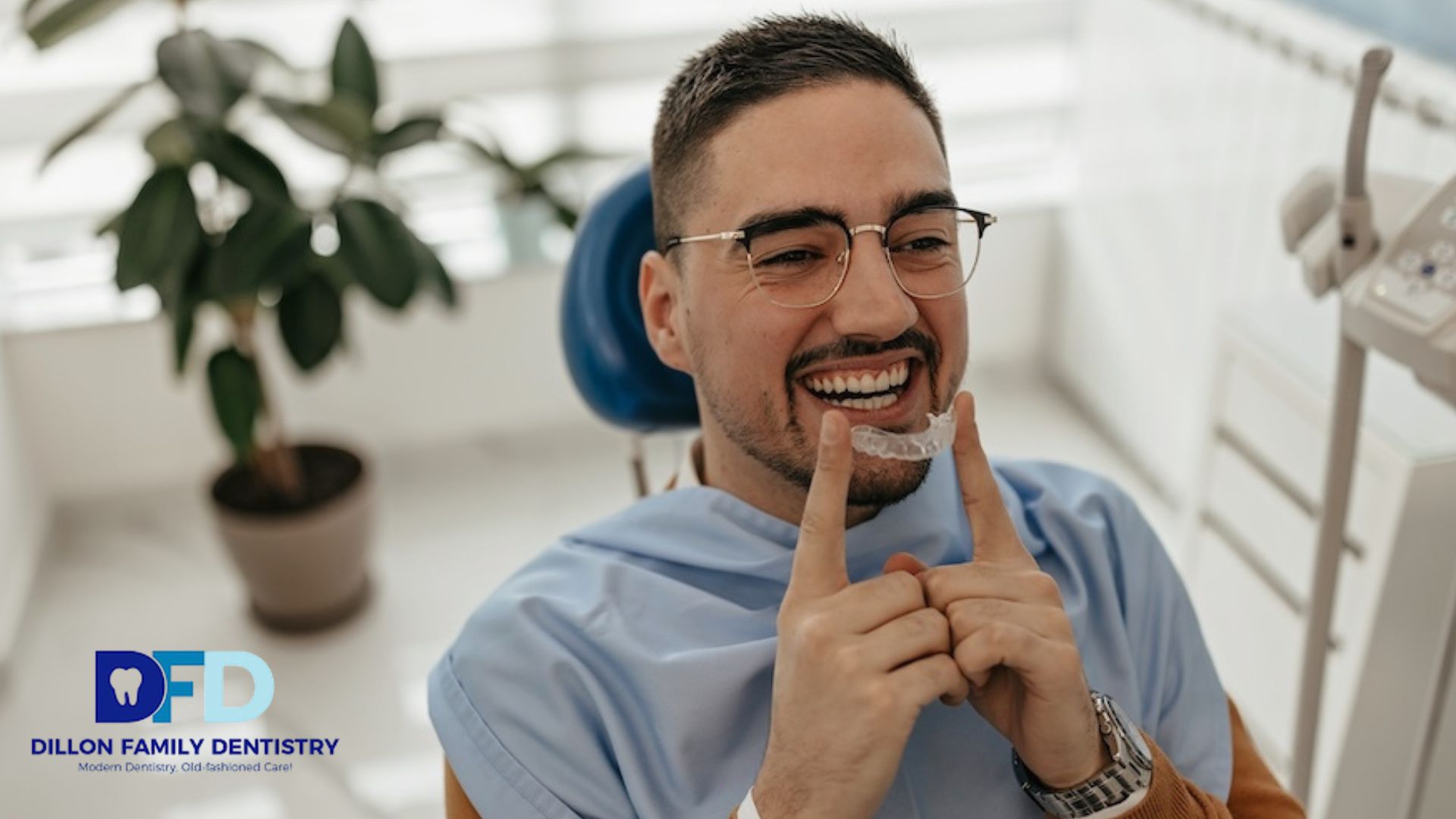
Invisalign aligners from Dillon Family Dentistry in Bryn Mawr, PA, are virtually invisible from day one; most patients and coworkers never notice them at all. After completing Invisalign treatment on the Main Line, your next step is wearing a retainer to lock in your results and prevent orthodontic relapse. Dr. David Dillon walks you through exactly what to expect, when the process feels completely normal, and how to protect your smile for life with proper post-Invisalign care in Bryn Mawr.
If you’ve ever sat at a lunch table along Lancaster Avenue, grabbed coffee at one of the local spots near Bryn Mawr College, or headed into work on the Main Line and found yourself wondering, “Can anyone actually see these aligners?” you’re not alone. That’s one of the very first questions I hear from new Invisalign patients here at Dillon Family Dentistry in Bryn Mawr, PA.
Let me give you the straight answer right up front: for most people, Invisalign aligners are functionally invisible from day one. But there’s a bit more nuance to that, and once you understand the full picture, from the first week of wearing your trays all the way through post-Invisalign retainer care, you’ll feel a whole lot more confident about the process.
I’ve been providing Invisalign treatment on the Main Line for decades, and I can tell you that the patients who feel the most comfortable in their aligners early on are the ones who understand what to expect. So let’s walk through this together.
The Short Answer: Invisalign Is Virtually Invisible From Day One
Here’s my standard statement to every person who comes to my office at Bryn Mawr: The aligners for Invisalign are made of a Clear, medical-grade thermoplastic material known as a Clear Aligner. When Aligners are properly positioned onto your teeth, they will fit so closely that you will hardly be able to tell they are on your teeth, as long as you don’t look for them.
That said, there are a few factors that affect how truly “invisible” they look:
- Fit and seating: Correctly applying the tray will enhance your appearance due to the lack of edge lift over your teeth. Correctly digitizing your teeth will ensure proper application of the trayed appliance throughout the orthodontic procedure, allowing the patient to wear the appliance properly.
- Attachments: Invisalign may need small attachments that are color-matched to your natural teeth, also called buttons, placed on some teeth to facilitate movement. They are sometimes a little more visible when viewed in close proximity to each other; however, in typical casual conversation, they are very hard for other people to see.
- Tray clarity over time: It is important to note that a new foil tray is likely going to develop stains (especially from coffee/tea) when it gets close to being changed out (1 to 2 weeks). Therefore, if you keep your tray on schedule for when to be changed out, your trays will continue to look new and clean.
- Lighting: Under bright overhead lights, a careful observer might catch a subtle shimmer. In normal social and professional settings? You’re fine.
The First Week: What “Getting Used to It” Actually Looks Like
I won’t sugarcoat the truth. Being honest with you will probably help you more than trying to be gentle about it. The first few days of using Invisalign Orthodontics on the Main Line are an adjustment period due not to the fact that your aligners can be seen, but because your body is getting used to the new feeling in your mouth.
Here’s what typically happens in week one:
- Your speech will adapt relatively rapidly; most patients experience a slight lisp or an altered “s” for the first 48 to 72 hours after having the trays put on and have essentially compensated naturally by the process of speaking. If you’re a speaker (teacher, presenter, etc.), we can time your start such that you will have a weekend to adjust before beginning your first day of work.
- Your saliva production will return to normal after some time. When the trays are first placed in your mouth, they can create an increase in saliva production through a physiological reaction that will also occur in your mouth. This increased saliva production is typically short-lived and may be reduced to baseline levels after about 2 to 3 days.
- Over time, your tongue will adapt to the new configuration of your mouth that resulted from having trays placed in it. After one week, many patients will not be able to tell that they are wearing trays at all.
At the end of the first week of using Invisalign to straighten teeth, typically, most of my patients in Bryn Mawr have stated that they no longer think about their aligner trays while enjoying their daily conversations or activities. This is when the true invisibility of an aligner begins to be realized!
When Does Invisalign Treatment End, and What Comes Next?
I have found that most of my Invisalign patients in Bryn Mawr and other towns along the Main Line complete the active phase of their orthodontic treatment using Invisalign between six months to eighteen months, depending on the complexity of their individual cases. So when you complete your last aligner in your first set, your new smile is now exactly like our original plan. Whether you think you deserve it or not, it is your right!
But too many patients come into my office after completing their last aligner and believe that the completion of their active treatment is the end of their orthodontic care. In reality, you are only halfway through until we can finish protecting your new smile!
The phase that comes after the completion of active treatment is the Retaining Your Result (or Retention) phase. To help protect your new smile during this phase, you will need to wear a retainer for an indefinite period until I determine you do not need them anymore; otherwise, if you do not wear your retainers regularly after your active treatment phase is over, you may never see your intended result again!
Post-Invisalign Care: Why Retainers Are Non-Negotiable
Let me break down how this all works in your mouth on a biological level. As you go through your Invisalign treatment, the teeth will move into position because the bone around them will begin to soften and break down a little bit, which allows movement of the teeth to take place (this is called bone resorption). After your final tray is removed, the teeth have moved into their proper position; however, the bone is not completely set in its new position yet. The process of new bone formation around your teeth (which locks them into their new position) can take around nine to twelve months.
So, while you wait for the new bone formation process to be complete, your teeth are at the greatest risk of shifting back to their previous position. If you do not wear a retainer after the completion of your Invisalign treatment, your teeth will shift back to where they were; it is only a matter of “how much” and “how fast”. This is called orthodontic relapse, and unfortunately, it is one of the most common problems I see with patients who have completed their Invisalign treatment along the Main Line in Pennsylvania.
The Retainer Schedule We Follow at Dillon Family Dentistry in Bryn Mawr
For my patients, I typically recommend the following post-Invisalign retainer care protocol:
1. Month 1-3 (Wear Retainer Full-time): You must wear your retainer for 20-22 hours each day (the same amount of time you wore your aligners). You can take them out to eat, drink anything besides water, or perform oral hygiene.
2. Month 4-6 (Shift): After you have worn your retainer full-time for three months, you may start to wear it mostly at night (transitioning towards that), but I would like to confirm with you in the office that your jawbone is stable before doing this.
3. 6+ months (Night-time Maintenance): The majority of patients are required to wear their retainers while they are sleeping only. However, those with prior histories of significant crowding may want to wear their retainers a few nights per week forever.
Is this forever? Technically, yes, some form of nighttime wear is the safest long-term approach. But for most of my Bryn Mawr patients, wearing their retainer to bed every night becomes as routine as brushing. It stops feeling like a burden very quickly.
What Happens If You Stop Wearing Your Retainer?
This is a popular inquiry that I have gotten frequently, so I wish to tell you the truth because you deserve truthful and trustworthy data and not fear-mongering.
If I miss a night, it is highly unlikely that there would be any type of significant shift from your previous position, especially after being out of braces for several months. Do not panic.
If you miss a week or 2, your retainer will feel somewhat tight when you first put it back on. This is your first indication of a problem to come. Wear your retainer for as many days as possible, and then it will normalize to its previous state.
If you miss a month or more, your teeth will have likely shifted enough to be visible; how your bite feels may have changed; and your retainer will not fit anymore. At this point, you need to return to see me. Depending on how far your teeth have moved, you may be able to be treated with a new retainer, or you may need to undergo a minor round of Invisalign to get your teeth back to their original position.
The most important point I need to make is if your retainer won’t go back into your mouth without being forced, do not do it. You can harm your teeth and gums. Come in so that I can examine the situation and we can work together to come up with a plan to return your teeth to their original position.
How to Care for Your Invisalign Retainers in Bryn Mawr
Retainer care is simple, but consistency matters. Here’s what I tell my patients:
- To clean your retainer every day, remember that a soft-bristle toothbrush and lukewarm water are the best tools to use. If needed, you can also use a non-scented soap. But avoid using any type of toothpaste because this will damage the surface of the retainer over time.
- Always remember to use lukewarm water. Hot water will deform the retainer, causing it to become unwearable.
- When you’re not wearing your retainer, be sure to use the storage case; newspaper and napkins do not count as storage cases. I’ve had many patients accidentally lose their retainer at work while eating lunch.
- Animals are also very attracted to a retainer, so always remember to keep it out of their reach.
- In general, both acrylic and thermoplastic retainers should be replaced every 6 months. If you notice any cracks, yellowing, or a noticeable change in the fit, you should see us for a replacement before you experience movement of your teeth.